

close
Choose Your Site
Global
Social Media
Views: 0 Author: Site Editor Publish Time: 2026-06-21 Origin: Site


Selecting the right drainage device is strictly critical for minimizing severe clinical complications. You want to avoid tube occlusion and accidental dislodgment at all costs. You must also ensure optimal patient comfort while maintaining steady, reliable fluid clearance. This remains a significant challenge for modern clinical procurement teams. Balancing material flexibility, specific structural designs, and appropriate lumen sizes against diverse application requirements demands careful evaluation. Pleural spaces, complex biliary tracts, and deep localized abscesses all require vastly different device configurations to succeed.
We provide an evidence-based, decision-stage framework for evaluating these critical medical tools. It helps you source the most effective configurations based entirely on clinical efficacy and strict risk management. You will learn how distinct material differences directly impact fluid flow rates and long-term tissue health. We will also explore how to match specific coiled tip designs to their ideal anatomical targets. This ensures better patient outcomes and streamlines your internal facility protocols.
Design Specificity: The choice between a single pigtail drainage tube and a double pigtail tube dictates retention strength and application suitability.
Material Matters: Polyurethane offers thinner walls for better flow at smaller French sizes, while silicone prioritizes long-term biocompatibility.
Application-Driven Sizing: Adult pleural drainage, pediatric interventions, and biliary stenting each require distinct lumen and coil configurations to prevent kinking or tissue trauma.
Risk Mitigation: Evaluating anti-kink mechanisms, hydrophilic coatings, and locking string integrity is essential for reducing replacement rates and improving patient outcomes.
Healthcare facilities constantly evaluate devices against strict core objectives. You want to reduce patient readmissions, minimize painful tube exchanges, and optimize continuous fluid flow rates. Achieving these goals requires moving beyond generalized medical supplies. You must select highly specialized tools tailored to precise anatomical environments. A poorly chosen device often leads to premature failure. This requires secondary invasive procedures and extends patient recovery times unnecessarily.
The standard pigtail drainage catheter offers distinct advantages over traditional straight surgical drains. Straight tubes rely heavily on external fixation and often irritate surrounding internal tissues. Conversely, the curled atraumatic tip of a coiled catheter minimizes internal tissue damage. The coiled shape naturally creates a wider surface area at the drainage site. It rests gently against sensitive organ walls. This inherent geometry dramatically enhances internal retention capabilities without requiring aggressive external suturing.
Buyers must proactively evaluate common failure risks before making final sourcing decisions. Drainage occlusion remains the most frequent complication. Thick purulent fluids easily block narrow lumens. You should match the inner diameter closely to expected fluid viscosity. Accidental dislodgment is another major risk factor. Uncooperative patients or routine physical movements can pull poorly secured tubes outward. Finally, insertion-site leakage occurs when the outer diameter mismatches the initial incision tract. Select devices utilizing gradual dilator kits to ensure a perfectly tight tissue seal.
Many clinical teams mistakenly assume larger tubes always guarantee better drainage. This represents a significant misunderstanding of fluid dynamics. Oversized tubes often cause intense insertion site pain. They also increase the likelihood of air leaks in pleural applications. You should always prioritize the smallest effective French size capable of handling the specific fluid type.
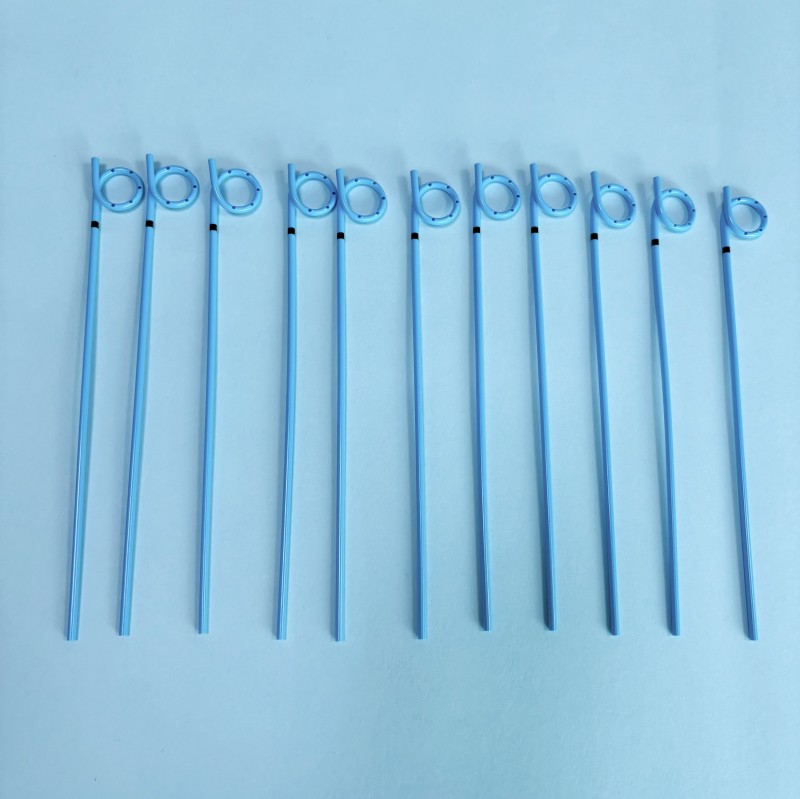
Understanding structural configurations is paramount for clinical success. Device architecture directly determines where and how you can deploy the drain safely.
A single pigtail drainage tube features one curled retention loop located exactly at the distal end. The proximal end remains straight and connects to an external drainage bag or suction valve. The primary mechanism relies on the internal coil gathering fluid while preventing the tip from migrating outward. The atraumatic loop shields surrounding tissues from the sharp suction eyelets.
This design handles percutaneous drainage of localized fluid collections perfectly. Clinical teams use them extensively for abdominal abscesses, simple pleural effusions, and basic nephrostomy procedures. They excel during short-to-medium-term gravity drainage protocols. Medical staff prioritize them when eventual removal ease is a strict procedural requirement.
A double pigtail tube utilizes a fundamentally different stabilization mechanism. It features tight coils at both the proximal and distal ends. This dual-coil architecture prevents device migration in two opposite directions simultaneously. It essentially anchors itself between two distinct anatomical boundaries.
Clinicians deploy these strictly for internal stenting applications. They do not protrude outside the patient's body. They maintain vital patency between two internal spaces without requiring external fixation. Ureteral stents utilize this shape to bridge the kidney and bladder. Internal biliary applications rely on them to keep bile ducts open. They represent a longer-term internal solution for strictures or blockages.
Many coiled drains incorporate an internal suture-locking mechanism. A thin tension string travels through the device lumen. When the physician pulls this string tight and locks it at the hub, it forces the distal tip into a rigid coil. This provides exceptional retention strength for high-risk dislodgment areas.
However, you must weigh this security against removal complexity. Non-locking designs pull out smoothly with gentle traction. Locking designs require staff to manually cut or release the internal string first. Forgetting to unlock the string causes severe tissue tearing upon removal. Facilities experiencing high staff turnover must implement rigorous training protocols if they standardize locking devices.
Material science fundamentally alters how a medical device performs inside the human body. Procurement criteria must prioritize physical properties over basic availability.
Polyurethane provides exceptionally high tensile strength. This structural rigidity allows manufacturers to create tubes featuring larger inner diameters inside smaller outer diameters. It maximizes fluid throughput while minimizing the insertion profile. Polyurethane easily resists collapse under negative suction pressure. It suits acute, high-flow environments seamlessly.
Silicone and its advanced copolymers offer a much softer physical profile. Silicone is highly biocompatible and chemically inert. It resists encrustation much better than polyurethane over extended periods. Pediatric departments strongly prefer silicone to protect fragile tissues. Long-term indwelling requirements mandate silicone to minimize foreign body tissue reactivity.
Specification Feature | Polyurethane | Silicone |
|---|---|---|
Tensile Strength | Very High | Moderate |
Wall Thickness | Thin (Allows larger internal lumen) | Thick (Requires larger outer profile) |
Tissue Reactivity | Low to Moderate | Extremely Low (Highly Biocompatible) |
Primary Clinical Use | Acute drainage, high suction, abscesses | Pediatric use, long-term indwelling |
Sizing decisions rely heavily on fluid physics, specifically the Poiseuille equation. This principle states fluid flow rate is directly proportional to the radius of the tube raised to the fourth power. A minuscule increase in internal diameter creates an exponential surge in fluid clearance.
Consequently, you do not always need massive surgical tubes. Blindly opting for larger French sizes (e.g., 14Fr or larger) is completely unnecessary for thin, non-viscous fluids like serous pleural effusions. Using oversized tubes for thin fluids needlessly increases patient trauma and procedural pain. Reserve 12Fr to 14Fr sizes strictly for thick purulent abscesses or heavy hemothorax scenarios.
Surface coatings dramatically alter insertion success rates. Hydrophilic coatings become ultra-slick when exposed to saline or bodily fluids. They reduce friction immensely during insertion over a guidewire using the standard Seldinger technique. This minimizes patient discomfort and prevents the tube from buckling mid-procedure. Additionally, some modern iterations feature specialized antimicrobial surface treatments. These coatings actively disrupt biofilm formation. They are highly recommended for devices remaining inside patients for over seven days.
You cannot adopt a universal approach to pigtail drainage tube selection. Different medical specialties face wildly distinct anatomical challenges. You must tailor your inventory to match specific departmental needs.
Major thoracic societies strongly endorse small-bore pigtail catheters as proven, safe alternatives to large-bore surgical chest tubes. For routine pneumothorax (air in the pleural space) or simple effusions, an 8Fr to 10Fr device performs flawlessly. The coiled tip prevents the device from puncturing the expanding lung during recovery. It eliminates the need for aggressive blunt dissection, allowing for a minimally invasive percutaneous approach. This drastically cuts down procedure times and accelerates patient mobility.
Neonatal intensive care units operate under extreme physical constraints. You must source ultra-low profile sizes ranging exclusively from 4Fr to 8Fr. Standard adult shafts are entirely too long and rigid. Pediatric variations require drastically shorter shaft lengths to properly accommodate tiny thoracic cavities. Soft silicone variations are mandatory here. A rigid polyurethane tip can easily erode fragile neonatal tissue during prolonged ventilation cycles.
The human biliary tract presents a highly hostile chemical environment. Standard plastics degrade quickly here. When treating obstructive jaundice, a dedicated biliary stent drainage tube becomes indispensable. You must evaluate these specific structural requirements:
Bile Salt Resistance: The polymer must withstand highly corrosive digestive enzymes without becoming brittle or fracturing over several months.
Precise Side-Hole Placement: Multiple large side holes must align perfectly within the bile duct and the duodenum to facilitate internal fluid bypass correctly.
Radio-Opacity: Biliary interventions rely heavily on fluoroscopy. The device must feature distinct radiopaque markers to confirm exact internal positioning across the stricture.
Acquiring top-tier devices solves only half the equation. You must also implement standardized risk management protocols and vet your manufacturing partners rigorously.
Even premium devices face eventual physical blockages. Fibrin sheaths naturally form around foreign objects inside the body. These protein layers eventually cover the drainage eyelets completely. Clinical teams must establish routine flushing protocols using sterile saline to maintain patency. When evaluating options, look for kink-resistant reinforced walls. A kinked shaft immediately stops all fluid flow and often demands complete device replacement. Reinforced polyurethane bodies resist this bending stress far better than unreinforced variants.
Standalone tubes offer little clinical value if they do not match your existing ecosystem. You must verify seamless integration. Check whether the inner lumen accurately accepts your hospital's standardized 0.035-inch or 0.038-inch guidewires. The external hub must feature universal Luer-lock or stepped connectors to integrate flawlessly with your current drainage bags. Purchasing pre-packaged kits containing perfectly matched dilators, scalpels, and guidewires often eliminates dangerous sizing mismatches during emergency procedures.
Procurement teams must audit potential suppliers using strict evidence-based criteria. Consider these vital checkpoints:
Clinical Evidence: Is robust clinical data or peer-reviewed evidence (matching PMC or MDPI rigor) available supporting this specific catheter design?
Sizing Gradients: Does the manufacturer offer highly reliable sizing gradients tailored for specific departments (e.g., rigid 12Fr for the ER, soft 6Fr for the NICU)?
Supply Chain Integrity: Are their internal supply chains robust enough to guarantee continuous delivery and completely prevent stockouts of critical sizes?
Training Support: Does the vendor provide clear educational materials for staff regarding complex locking mechanisms and safe removal procedures?
No single coiled device fits every clinical scenario perfectly. The "best" overarching design strictly aligns specific structural features against the target anatomy and expected fluid viscosity. You must carefully balance material stiffness, single versus double coil architecture, and the necessity of locking mechanisms. Polyurethane handles high-flow acute situations, while silicone masters long-term gentle care. Small bores handle air seamlessly, whereas larger lumens remain necessary for thick purulent collections.
Clinical procurement teams should run localized audits on their current failure rates immediately. Analyze your internal records regarding accidental dislodgments versus tube occlusions. If dislodgment rates appear unusually high, you likely need to shift toward locking mechanisms. If occlusion remains your primary headache, re-evaluate your French sizing matrix and flushing protocols. Aligning your purchasing strategy with these documented clinical realities ensures safer procedures and much smoother patient recoveries.
A: A single pigtail tube features one retention coil. It drains fluid from an internal cavity outward into an external collection bag. A double pigtail tube features retention coils at both ends. Clinicians use it strictly for internal stenting. It bridges two internal organs, maintaining fluid flow between them without protruding outside the body.
A: You base the size primarily on fluid viscosity. Air or thin serous fluid requires much smaller sizes, typically 8Fr to 10Fr. These maximize comfort. Thick, purulent, or viscous fluids require larger sizes, generally 12Fr to 14Fr or higher. Larger sizes prevent dangerous occlusions during heavy drainage.
A: You prefer them when maintaining ductal patency is required. They facilitate natural internal bile flow directly into the duodenum. Standard drains cannot survive this environment. Biliary versions utilize highly specialized materials engineered to resist aggressive degradation caused by corrosive bile salts over extended periods.
A: Yes, they require a specific unlocking procedure first. Staff must release or cut the internal tension string before attempting removal. Failure to unlock the coil causes the rigid tip to tear surrounding tissue upon extraction. Thorough staff training remains a critical factor for successful implementation.


