

close
Choose Your Site
Global
Social Media
Views: 0 Author: Site Editor Publish Time: 2026-08-23 Origin: Site


It is a common engineering paradox that the exact same polymer used to manufacture thick, rigid white plumbing pipes is also the most widely utilized material for highly pliable, clear fluid delivery in healthcare. The transformation of inherently brittle polyvinyl chloride (PVC) into flexible medical components is a foundational process in medical device manufacturing. Medical device engineers must balance the demand for extreme flexibility, such as kink resistance and routing ease, with strict biocompatibility requirements, sterilization survivability, and high-volume manufacturing economics. Selecting the wrong compounding formulation can lead to plasticizer leaching, mechanical failure, or regulatory rejection. Understanding the exact mechanisms of PVC plasticization, extrusion methodologies, and material trade-offs is critical for specifying reliable components. You need this knowledge to design standard IV lines, suction equipment, or highly specialized catheters without compromising patient safety or production yields.
Chemical Modification is Mandatory: PVC achieves flexibility exclusively through the addition of plasticizers, which embed between polymer chains to increase free volume and reduce the glass transition temperature.
Formulation Dictates Compliance: The shift away from DEHP (di-2-ethylhexyl phthalate) requires evaluating non-phthalate alternatives (like TOTM or DOTP), while ensuring the final compound remains strictly BPA-free and latex-free to meet modern ISO 10993 and REACH standards.
Extrusion Precision: Manufacturing a reliable single lumen tube requires strict control over melt temperatures, tooling geometry, and cooling rates to maintain tight dimensional tolerances and prevent ovalization.
Material Trade-offs: While flexible PVC medical tubing offers unmatched cost-to-performance ratios and clarity, engineers must weigh its plasticizer leaching risks against the higher costs and processing complexities of alternatives like TPE or TPU.
Unmodified PVC cannot bend or route without fracturing. The raw polymer possesses a highly rigid molecular structure that shatters under mechanical stress. The success of a flexible PVC formulation relies on achieving a specific Shore A hardness, typically ranging from 65A for highly pliable pump segments to 85A for structural drainage lines. Engineers must reach this flexibility while maintaining optical clarity for fluid monitoring. This transparency allows clinicians to observe flow rates and detect microscopic air bubbles instantly. The modified material must allow the tube to be handled, coiled, and manipulated without tearing or cracking during clinical procedures.
Plasticizer molecules physically bond with the PVC resin. They do not form chemical bonds with the polymer matrix. Instead, these additives embed themselves between the long polymer chains. This physical separation increases the free volume within the material structure. It effectively reduces the intermolecular forces holding the rigid chains together. As a result, the polymer chains can slide past one another under stress. This internal lubrication lowers the glass transition temperature (Tg) from approximately 80°C down to well below room temperature. It transforms a rigid, brittle structure into a highly pliable elastomer suitable for medical routing. The ratio of plasticizer to resin, measured in parts per hundred resin (phr), directly dictates the final flexibility.
The choice of plasticizer defines the physical and chemical profile of the tubing. Orthophthalates, specifically DEHP, represent the legacy standard. They offer excellent flexibility and unmatched compounding efficiency. However, DEHP faces severe regulatory scrutiny worldwide. Concerns regarding leaching and endocrine disruption have driven the industry toward safer alternatives. Trimellitates, such as TOTM, provide lower migration rates. They remain highly stable within the polymer matrix. Engineers frequently specify TOTM for blood contact applications and long-term fluid delivery. Terephthalates like DOTP and Citrates like ATBC serve as emerging non-phthalate standards. They offer excellent performance for general-purpose PVC medical tubing without the associated regulatory risks.
Plasticizer Type | Chemical Category | Migration Risk | Primary Medical Application |
|---|---|---|---|
DEHP | Orthophthalate | High | Legacy general-purpose lines (phasing out) |
TOTM | Trimellitate | Very Low | Blood bags, hemodialysis lines, long-term contact |
DOTP | Terephthalate | Low | Standard IV lines, respiratory tubing |
ATBC | Citrate | Low | Neonatal care, sensitive fluid delivery |
Beyond plasticizer selection, medical-grade PVC formulations demand strict purity controls. The compounds must be explicitly certified as BPA-free. They must also be entirely latex-free. These baseline requirements prevent severe allergic reactions in sensitive patient populations. They also eliminate the risk of systemic toxicity caused by residual chemical contaminants. Manufacturers must source raw resins with a specific K-value (typically around 70 for flexible extrusion) that comply with stringent pharmacopeia standards. Heavy metal stabilizers, once common in industrial PVC, are strictly prohibited. Calcium-zinc stabilizers are utilized instead to prevent thermal degradation during the extrusion process.
Plasticizer migration into drug solutions or bodily fluids remains the primary implementation risk. When fluids flow through the tubing, they can extract plasticizer molecules from the polymer matrix. This leaching alters the drug efficacy and exposes the patient to unintended chemicals. Mitigation requires matching the plasticizer type to the specific fluid path. Lipophilic drugs, such as Propofol or Paclitaxel, accelerate plasticizer extraction aggressively. Engineers must evaluate the contact duration and fluid chemistry to select a low-migration formulation. Proper material specification neutralizes this inherent risk before the device reaches clinical trials.
Manufacturing relies on a continuous extrusion process specific to flexible PVC. The journey begins with a compounded polymer pellet containing the precise ratio of resin, plasticizer, and thermal stabilizers. These pellets enter the extruder hopper and feed into a heated barrel. A rotating screw generates friction and shear, melting the polymer into a viscous fluid. The barrel utilizes distinct heating zones to gradually bring the melt up to approximately 170°C to 180°C. This homogeneous melt flows under high pressure through a screen pack to filter un-melted particles, then enters the crosshead die. Upon exiting the die, the shaped profile immediately enters a water cooling bath. The rapid temperature drop solidifies the polymer, locking in the final dimensions.
Tooling geometry directly dictates the physical dimensions of the Single Lumen Tube. The extrusion die shapes the outer diameter (OD) of the profile. Simultaneously, an internal pin or mandrel forms the inner diameter (ID). Air pressure applied through the mandrel prevents the hollow structure from collapsing during the cooling phase. Engineers must calculate precise draw-down ratios (DDR) to achieve the target specifications. This involves balancing the extruder screw speed with the downstream puller speed.
Tooling Selection: Match the die and mandrel size to the target OD/ID, factoring in the expected polymer swell as it exits the die.
Temperature Profiling: Set the barrel zones (feed, compression, metering) to create a smooth melt without degrading the PVC.
Air Pressure Calibration: Adjust the internal air flow to maintain the lumen shape without blowing out the tube walls.
Cooling Bath Positioning: Set the air gap between the die face and the water bath to control the initial draw-down tension.
Puller Synchronization: Lock the puller speed to the extruder output to maintain strict dimensional tolerances.
Proper synchronization achieves final dimensions without inducing residual mechanical stress. Excessive draw-down tension causes the tubing to shrink or warp post-extrusion, especially during subsequent heat sterilization cycles.
Kink resistance dictates how well the tubing performs in a clinical setting. Wall thickness and Shore hardness correlate directly to the tube's bend radius. A tighter bend radius without occlusion ensures the tube can be dynamically routed around patient beds and equipment. If the wall is too thin or the material too soft, the lumen will collapse under bending stress. Surface finish represents another critical evaluation metric. Highly plasticized PVC often exhibits surface tackiness. This stickiness complicates handling, uncoiling, and automated assembly processes. Manufacturers utilize specific cooling techniques, such as frosting the extrusion die or applying a micro-matte finish, to prevent tackiness. A smooth, low-friction exterior ensures seamless clinical deployment.
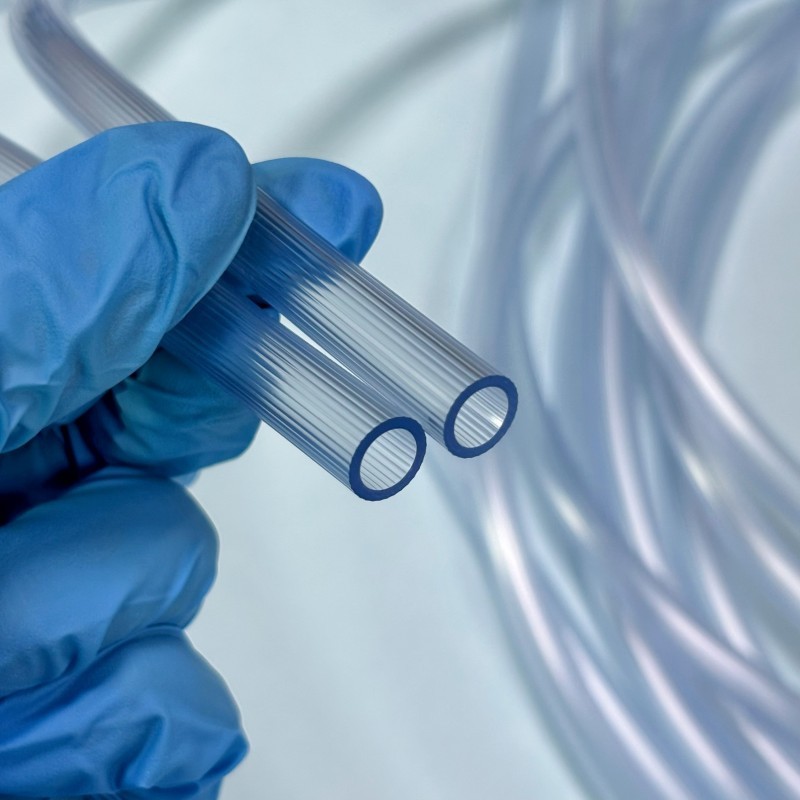
Advanced fluid delivery systems often require properties that a single material cannot provide. Specifying co-extruded PVC tubing solves this by combining multiple polymer layers into a single continuous profile. An engineer might specify a rigid PVC outer layer for burst strength and structural integrity. They can pair this with a highly flexible, low-migration inner layer (like polyethylene or a specialized non-phthalate PVC) for direct fluid contact. This multi-layer approach optimizes both mechanical performance and chemical safety.
Delamination at the polymer interface presents a significant implementation risk. If the layers separate during clinical use, the device fails catastrophically. Mitigation involves precise temperature matching during extrusion to ensure both melt streams possess similar viscosities when they meet in the crosshead die. Engineers also utilize specialized tie-layers (such as EVA) when combining highly dissimilar polymers to ensure a permanent mechanical bond.
Catheter design pushes the limits of extrusion technology. The primary application goal involves maximizing the inner diameter for high flow rates. Simultaneously, engineers must minimize the outer profile to ensure patient comfort during insertion. Designing a PVC thin wall catheter requires exceptional tooling precision. Maintaining concentricity is the primary manufacturing challenge. If the wall thickness varies around the circumference by even a few thousandths of an inch, the catheter will kink unevenly during navigation through the body.
Preventing wall collapse during the extrusion cooling phase requires micro-adjustments to internal air pressure. Furthermore, the thin walls must withstand subsequent sterilization processes without deforming or losing their structural integrity. Manufacturers often employ an annealing process, passing the extruded catheter through a secondary heat tunnel to relieve internal stresses and prevent longitudinal shrinkage.
Intravenous therapy relies heavily on the unique properties of flexible PVC. These applications leverage the exceptional optical clarity of PVC single lumen tubing. Clinicians must easily monitor fluid flow rates at a glance. They also need to detect microscopic air bubbles or particulate matter instantly. The inherent transparency of the material allows for rapid visual inspection, enhancing patient safety.
The material's flexibility allows the IV line to drape naturally from the fluid bag to the patient access site. It resists kinking when routed through infusion pumps. For pump segments specifically, the PVC must possess high fatigue resistance to withstand the continuous compression and decompression of the peristaltic pump rollers without permanently deforming or altering the internal volume.
Surgical suction and wound drainage systems operate under demanding physical conditions. These devices utilize the high kink resistance and structural memory of flexible PVC. The tubing must maintain an open lumen under continuous negative pressure environments. If the walls collapse under vacuum, the suction fails, potentially compromising the surgical field.
Engineers formulate the PVC to possess enough rigidity to resist vacuum forces, often utilizing a Shore 80A to 85A compound. At the same time, the material remains flexible enough for surgeons to manipulate the suction tip precisely. This balance of crush resistance and pliability makes PVC the standard for high-volume drainage applications. In some designs, engineers incorporate a ribbed outer wall to further enhance crush resistance while maintaining a thinner, more flexible base wall.
Engineers constantly evaluate PVC against alternative polymers based on specific application demands. Thermoplastic Elastomers (TPE) offer flexibility without the need for plasticizers. This inherent flexibility means there is zero leaching risk, making TPEs ideal for sensitive drug delivery. They also feature a lower density, reducing overall part weight. However, TPEs typically lack the glass-like clarity of PVC. They also present challenges for solvent-bonding during assembly, often requiring mechanical connectors or UV-cured adhesives.
Thermoplastic Polyurethanes (TPU) provide superior tensile strength and exceptional lipid resistance. Their burst pressure capabilities far exceed standard PVC formulations. Yet, TPUs come at a significantly higher raw material cost and require more complex extrusion parameters, including strict moisture control prior to processing.
Material | Clarity | Leaching Risk | Assembly Method | Relative Cost |
|---|---|---|---|---|
Flexible PVC | Excellent (Glass-like) | Varies by plasticizer | Solvent Bonding (Cyclohexanone) | Low |
TPE | Moderate (Hazy) | Zero | Mechanical / UV Adhesive | Medium |
TPU | Good | Zero | Solvent / RF Welding | High |
Despite the rise of alternative polymers, flexible PVC remains the dominant choice for high-volume, disposable applications. The cost-to-performance ratio is largely unmatched in the medical device industry. PVC resin is highly economical to produce and compound. The extrusion process is well-understood and highly efficient, resulting in low manufacturing scrap rates.
Furthermore, PVC readily accepts solvent bonding. Applying a small amount of cyclohexanone or THF to the tubing exterior slightly dissolves the polymer, allowing it to fuse permanently with rigid plastic connectors (like ABS or polycarbonate luer locks). This allows for rapid, low-cost automated assembly. Engineers typically specify more expensive alternatives like TPE or TPU only when strict chemical compatibility or extreme mechanical performance dictates the necessity.
Medical tubing must pass rigorous biological evaluation before clinical use. The ISO 10993 series dictates the testing protocols for biocompatibility. Laboratories test the specific PVC compound for cytotoxicity (ISO 10993-5), ensuring it does not damage living cells. They evaluate sensitization (ISO 10993-10) to confirm the material does not provoke allergic responses. Hemocompatibility testing (ISO 10993-4) ensures the tubing does not destroy red blood cells or trigger unintended clotting.
USP Class VI represents another critical baseline requirement. These tests evaluate systemic toxicity and intracutaneous reactivity in animal models. Passing these stringent evaluations proves the formulated compound is safe for human contact. Any change to the plasticizer, resin, or colorant requires a complete re-validation of the biological safety profile.
Medical devices must survive terminal sterilization without degrading. Ethylene Oxide (EtO) gas remains highly compatible with flexible PVC. It serves as the standard sterilization method for high-volume disposables. The gas penetrates the polymer matrix effectively and dissipates predictably during the aeration phase.
Gamma irradiation offers a faster sterilization cycle but presents material challenges. High-dose radiation can cause slight yellowing or induce cross-linking in the PVC matrix, leading to embrittlement. Engineers must specify radiation-stabilized formulations to withstand gamma exposure. Often, a slight blue tint is added to the compound to visually offset the expected yellowing. Autoclave or steam sterilization is generally avoided for highly plasticized PVC. The elevated temperatures (typically 121°C) cause the material to soften past its heat deflection temperature, leading to severe deformation, lumen collapse, and melting risks.
Define exact inner and outer diameter tolerances, including the required concentricity limits for your specific fluid delivery application.
Select the appropriate non-phthalate plasticizer based on the intended drug contact, prioritizing TOTM or DOTP for sensitive fluid paths.
Request comprehensive material data sheets and ISO 10993 biological test reports from your extrusion partner before finalizing the compound.
Initiate prototype sampling to validate mechanical performance, kink resistance, and solvent bonding compatibility on your assembly line.
A: The base polymer is identical, but medical tubing is compounded with high concentrations of plasticizers. These additives embed between the rigid polymer chains, increasing free volume and transforming the stiff plastic into a highly pliable, clear elastomer.
A: A single lumen tube is an extruded cylindrical structure with one continuous, unobstructed inner channel (lumen) used for the unidirectional transfer of fluids, gases, or surgical instruments.
A: Yes, modern medical-grade PVC formulations are strictly manufactured without Bisphenol A (BPA) or natural rubber latex to ensure broad biocompatibility and prevent allergic reactions in patients.
A: Yes. Due to regulatory and health concerns regarding DEHP leaching, manufacturers now frequently use non-phthalate plasticizers like TOTM (Trioctyl trimellitate), DOTP (Dioctyl terephthalate), and ATBC (Acetyl tributyl citrate).
A: Co-extrusion involves simultaneously extruding two or more layers of polymer into a single tube. This allows engineers to combine different material properties, such as a chemically resistant inner layer with a highly flexible, low-cost PVC outer layer.
A: Yes, but gamma irradiation can cause slight yellowing or polymer cross-linking. To prevent embrittlement and color shifts, manufacturers must use specific radiation-stabilized PVC formulations designed to withstand the sterilization process.


