

close
Choose Your Site
Global
Social Media


| Quantity: | |
|---|---|
LDPE/PEBAX
Bova


LDPE / Pebax available in multiple materials, specifically for interventional and minimally invasive treatments.
 | Product Overview |
Medical tearable sheaths (also known as axially tearable sheaths or tearable catheter sheaths) are core auxiliary devices used in interventional surgeries and minimally invasive treatments to protect internal catheters, guidewires, and electrode leads. Traditional catheter sheaths require surgical scissors for removal, which can easily damage the internal catheter, break the lead wires, or even injure blood vessels and surrounding tissues with the scissors. This product uses an innovative axially tearable technology, allowing medical personnel to completely tear off the sheath wall manually along its axis without the need for additional cutting tools, eliminating the risks associated with cutting operations from the outset.
Bova has deep expertise in the field of medical precision extrusion. Its medical tearable tubes are made from high-molecular raw materials such as LDPE and Pebax that meet medical standards. Through precision extrusion technology, uniform wall thickness and controllable flexibility are achieved. The tube body can bend naturally with human cavities, with excellent conformability, effectively reducing tissue irritation and trauma during surgery, reducing postoperative complications, and is widely applicable to various clinical scenarios such as cardiovascular intervention, neurointervention, peripheral drainage, and electrophysiological implantation.
| Core performance advantages |
Axial easy-tear design, zero operational risk
The tube body has a pre-installed directional tear-off structure, allowing for complete axial tearing by hand while wearing medical gloves. The tear is smooth and the force is evenly distributed, eliminating the need for surgical scissors or other auxiliary instruments. The operation process offers a clear field of vision and high controllability, completely avoiding damage to internal instruments and scratches to human tissue caused by limited vision or loss of force during cutting, significantly improving the safety of instrument removal.
Flexible tube wall, reducing intraoperative trauma
Utilizing a high-precision extrusion molding process, the tube wall has uniform thickness and controllable flexibility, naturally adapting to the physiological curvature of blood vessels and body cavities. This minimizes friction and irritation to tissues during insertion and removal, reducing the risk of endothelial damage and mucosal bleeding, alleviating patient discomfort during surgery, and shortening the postoperative recovery period.
Medical-grade raw materials, reliable biocompatibility
All products are manufactured using medical-grade polymer raw materials, with traceable batches, no harmful substances leaching out, and biocompatibility meeting medical consumable standards, allowing safe short-term contact with human tissues and fluids. The entire production process adheres to quality management standards, and finished products undergo rigorous appearance and dimensional inspections to ensure stability in clinical use.
High adaptability and customization support
It can be matched with catheters, guidewires, electrodes and other internal instruments with different outer diameters, and supports full parameter customization of inner diameter, wall thickness, length and color; at the same time, it can be equipped with secondary processing technology such as tube body scale printing, imaging ring implantation, tip chamfering and forming, multi-lumen structure, etc., to meet the differentiated needs of different departments and different procedures.
| Material Selection Guide |
We offer a variety of mainstream medical material options, allowing for flexible selection based on surgical precision, biomechanical requirements, and cost budget:
Low-density polyethylene (LDPE) is flexible, has balanced tear resistance, good processability, excellent chemical resistance and low-temperature toughness, and offers outstanding cost performance.
Key features: Excellent flexibility, easy tearing, high cost-effectiveness
Recommended scenarios: Routine interventional drainage, general laparoscopic diagnosis and treatment, disposable nursing catheter kits, basic interventional procedures
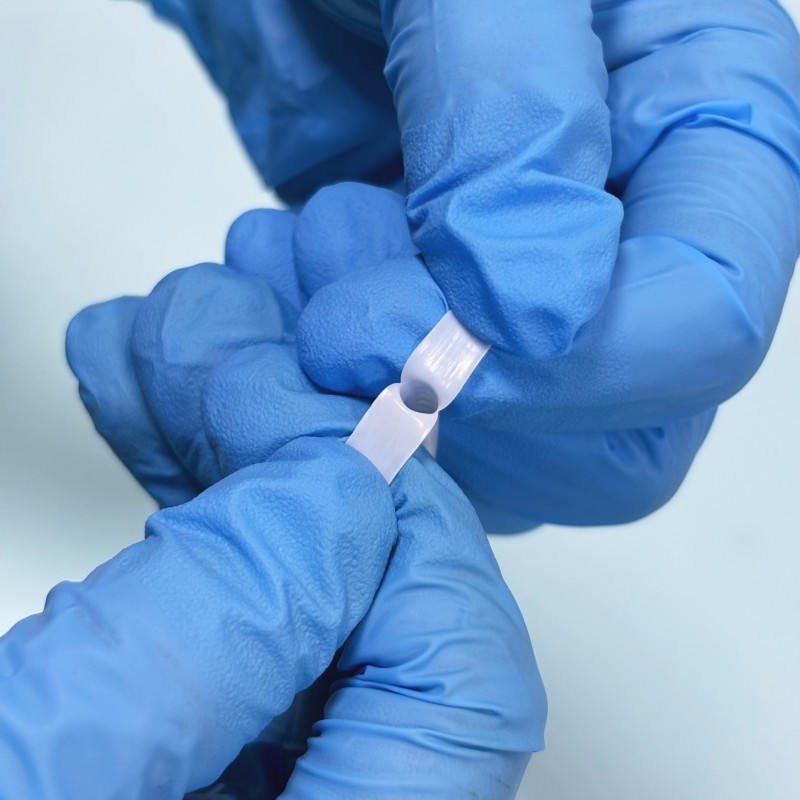
Pebax, a mainstream material for high-end interventional devices, combines high strength and high resilience, exhibiting excellent bending and fatigue resistance, high tube smoothness, and low resistance to the advancement of internal instruments.
Key Features: High strength, bending resistance, low friction, high-precision fit
Recommended Scenarios: Complex and high-precision surgeries such as neurointerventions, cardiovascular interventions, and peripheral vascular interventions, as well as diagnostic and treatment scenarios requiring repeated bending and advancement.
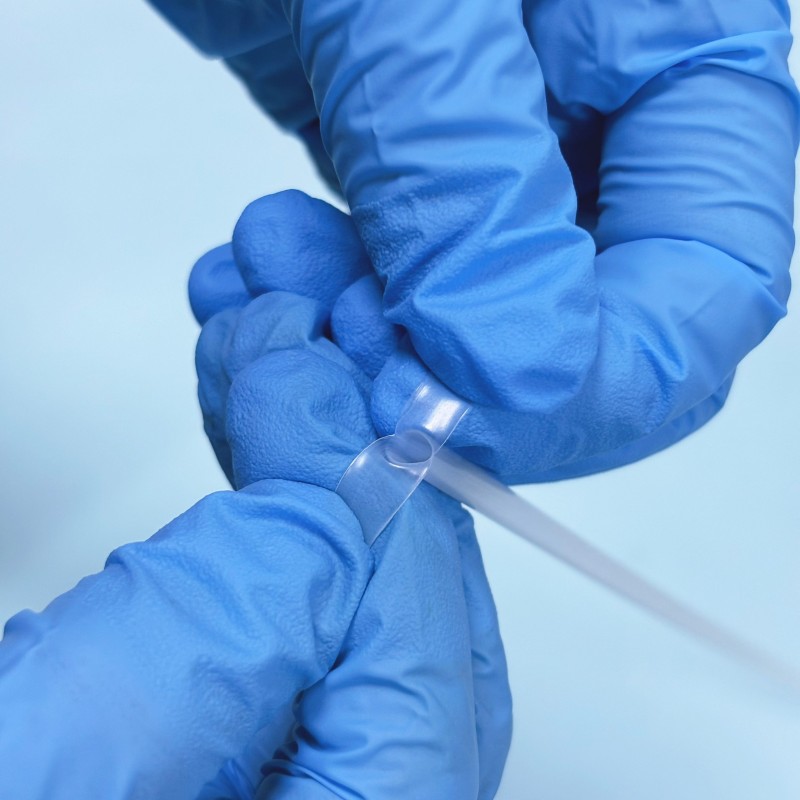
| Clinical application scenarios |
Medical tearable tubes, with their safety, high efficiency, and low invasiveness, have become a common accessory in the field of minimally invasive diagnosis and treatment. Typical applications include:
Cardiovascular interventional procedures: In procedures such as coronary angiography, stent implantation, and balloon angioplasty, it serves as a protective sheath for guidewires and balloon catheters, and is safely detached and removed post-procedure.
Neurointerventional procedures: High-precision procedures such as intracranial vascular embolization, thrombectomy, and angiography, used with microcatheters to minimize the risk of vascular injury.
Peripheral interventions and drainage: Protection of drainage tubes and placement instruments in scenarios such as thoracic and abdominal drainage, biliary drainage, urological interventions, and central venous catheterization.
Electrophysiological implantation: When implanting leads such as pacemaker electrodes, neurostimulation electrodes, and ablation catheters, this sheath serves as an insertion sheath. When tearing it open for removal, it prevents traction damage to the electrodes.
Endoscopic and laparoscopic surgery: In minimally invasive procedures such as digestive endoscopy, thoracoscopy, and laparoscopy, the use of an instrument channel simplifies the instrument retrieval process.
Comparison with traditional peel-away sheaths
| Comparison dimensions | Traditional peel-away sheath | Bova Axial Tear-Away Tube |
|---|---|---|
| Retrieval method | Requires cutting with surgical scissors; the operative field is restricted | Tear open manually along the axis; operation is intuitive and controllable. |
| Built-in instrument protection | High risk of the instrument being rendered unusable due to the ease with which catheters can be punctured or guidewires severed. | The avulsion process involves no contact with internal instruments, resulting in zero damage. |
| Organizational safety | The tips of the scissors can easily scratch blood vessels and surrounding tissues | No sharp instruments involved; extremely low risk of tissue abrasion. |
| Operational efficiency | Requires auxiliary tools, involves multiple steps, and is time-consuming | Completed in a single step using a manual technique, reducing the duration of the surgical procedure. |
| Postoperative effects | Instrument-related damage and tissue abrasions can easily lead to complications | Minimal trauma, low complication rate, and faster recovery. |
Standardized Production in Class 10,000 Cleanrooms
Bova medical tear-away tubing is manufactured entirely within Class 10,000 cleanrooms, strictly adhering to quality management systems for medical polymer consumables. Comprehensive quality control and batch traceability are implemented across the entire process—from raw material inspection, extrusion molding, and post-processing to final product dispatch. Products are supplied non-sterile by default, with sterilization solutions available upon customer request.
We provide full-spectrum customization services tailored to your product designs and clinical requirements:
Custom Dimensions: Inner diameters of 0.5mm–20mm, wall thicknesses of 0.1mm–2mm, and lengths customized to specifications.
Custom Materials: A wide range of medical-grade materials available, including LDPE, Pebax, TPU, and HDPE.
Custom Processing: Secondary processing options such as graduation printing, radiopaque marker band embedding, tip forming, multi-lumen structures, and hole punching.
| Frequently Asked Questions (FAQ) |
Q: Is the medical tear-off tube for single use?
A: This product is a single-use medical consumable. It is not recommended for repeated sterilization to avoid cross-infection and safety hazards caused by material performance degradation.
Q: Is it difficult to tear open? Is special training required?
A: It is very easy to operate. The tube has a pre-installed axial tear-off guide structure. Wearing regular medical gloves, it can be torn open by hand. Medical personnel can quickly learn to use it without complicated training.
Q: Can you provide samples for testing?
A: Yes. We can provide sample making services based on parameters or drawings provided by customers, adapting to the needs of different stages such as R&D testing and clinical validation. We can undertake both small-batch trial production and large-scale supply.
Bova medical tearable catheters are designed with "safety, minimal invasiveness, and high efficiency" as their core design goals. Their innovative axially tearable structure solves the problems of instrument damage and tissue abrasion during traditional catheter sheath removal. Combined with a multi-material matrix including LDPE and Pebax, and flexible customization capabilities, they comprehensively cover all scenarios from basic drainage to advanced interventional procedures, making them a top choice for high safety and cost-effectiveness among medical catheter devices.
For detailed specifications, material testing reports, or customized quotes for our medical tearable catheters, please contact us. We will provide professional technical support and selection advice.


