close
Choose Your Site
Global
Social Media
| ★ | Material:LDPE(Low-Density Polyethylene) |
Low-Density: This is because its polymer chains have more branches, and the molecules are not arranged so tightly, resulting in a lower density. Polyethylene: Polyethylene is a thermoplastic plastic polymerized from ethylene monomers. |
 | Detailed Display |

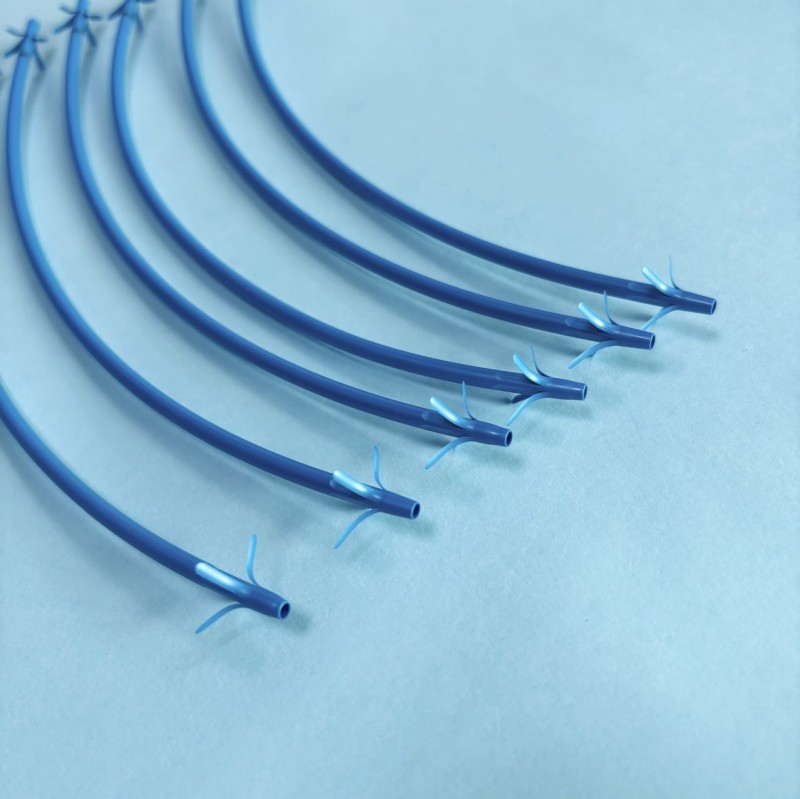
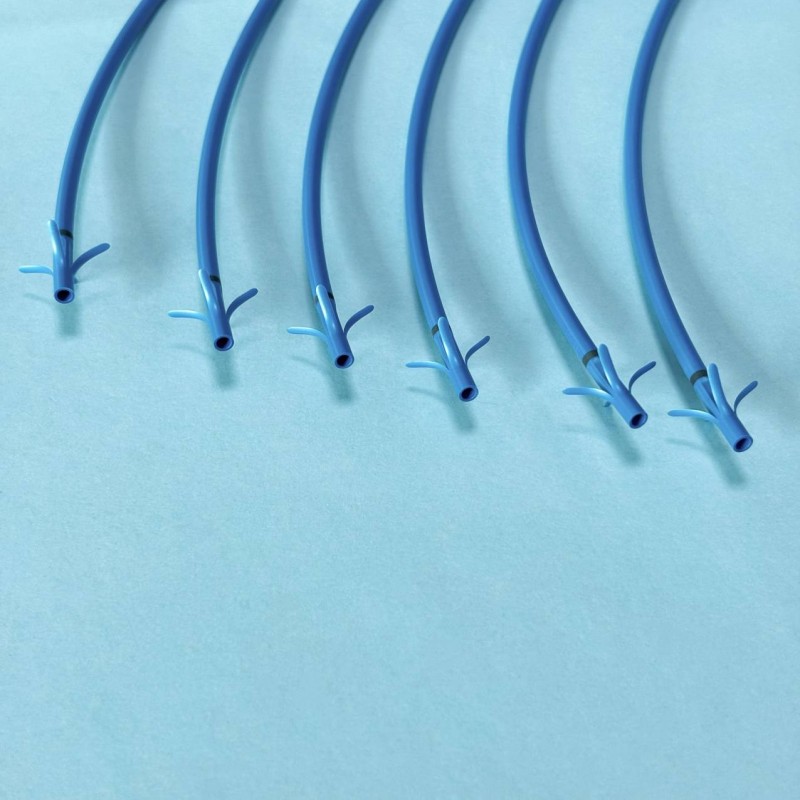
Biliary stent

Biliary stent
1.Traditional biliary stents are mostly straight tubes, and their main problems are displacement (slipping upwards into the liver or downwards into the intestines) and blockage (bile stasis, bacterial film formation, or tumor ingrown growth).
2.The design inspiration for "Christmas tree-shaped" stents is precisely to overcome these shortcomings:
Anchoring and Anti-Slip: The stent's ends are designed with a series of barbs or umbrella-shaped protrusions, resembling a Christmas tree. After implantation, the upper "branches" are anchored in the intrahepatic bile ducts, and the lower "branches" are anchored in the duodenum, effectively preventing the stent from sliding up and down within the bile duct using mechanical resistance.
3.Unobstructed Drainage: The middle section maintains patency, ensuring that bile can flow smoothly from the liver into the intestines.
4.Anti-Reflux (in some designs): Some designs also include an anti-reflux valve at the lower end to prevent intestinal fluid from flowing back into the bile duct, reducing the risk of infection.
| Characteristic | Contribution to the "Christmas Tree" type stand |
| Excellent flexibility and elasticity | This is the most critical characteristic. The "Christmas tree-shaped" barbed structure needs to be able to compress to pass through narrow bile ducts and delivery devices, and then elastically return to its original shape after reaching the designated position to achieve anchoring. LDPE's high elasticity enables it to perform this process without plastic deformation or breakage. |
| Good flexural strength and kink resistance | The bile duct is not a straight tube. LDPE stents are less likely to collapse or twist in the curved anatomical structures, keeping the lumen continuously open and ensuring effective drainage. |
| Biocompatibility | LDPE, as a mature medical polymer material, exhibits minimal tissue reaction and is relatively stable in the biliary environment, allowing for long-term implantation (usually several months). |
| Easy to process and shape | Complex "Christmas tree" shapes can be precisely manufactured using processes such as extrusion and injection molding, while ensuring consistency between batches. |
| Moderate stiffness and flexibility | Compared to the softer silicone, LDPE offers a certain level of support; compared to the harder metals or HDPE, it is flexible enough. This balance allows it to maintain the lumen without causing excessive pressure or damage to the bile duct wall. |
This type of stent is primarily used to treat benign or malignant biliary obstructions, and is particularly advantageous in the following situations:
Patients at high risk of stent migration: such as those with significant bile duct dilation, or those whose sphincter muscles have been cut or lost function.
Patients requiring long-term drainage: For inoperable malignant obstructions (such as pancreatic cancer, bile duct cancer) or benign strictures requiring long-term support (such as postoperative scarring, chronic pancreatitis), its anchoring design provides long-term stable drainage.
Alternative to partial surgery: As part of minimally invasive interventional treatment, it is implanted via ERCP (endoscopic retrograde cholangiopancreatography) or PTCD (percutaneous transhepatic biliary drainage), resulting in minimal trauma.
The core value of LDPE Christmas tree-shaped biliary stents lies in achieving better "in-situ rate" and "patency rate" through ingenious physical design and appropriate material selection.
Advantages:
1.Significantly reduced displacement rate: This is its most prominent advantage, avoiding repeat surgeries due to displacement.
2.Reliable drainage: The flexible and resistant material properties ensure continuous drainage.
3.Removability: Like some covered metal stents, LDPE plastic stents can be relatively easily removed or replaced endoscopically when needed.
limitation:
1.Potential for clogging: All plastic stents face the challenge of bacterial biofilm and sludge accumulation, posing a risk of clogging even after long-term implantation, requiring regular replacement (usually every 3-6 months).
2.Relatively smaller diameter: Due to material strength and delivery system limitations, their inner diameter is typically smaller than some metal stents, theoretically potentially resulting in a slightly lower drainage rate.
3.Higher price than standard straight-tube plastic stents.